
Are we doomed?
(No – and we should fight for every tenth of a degree)

Dearest readers, today, I have an incredibly obvious and unsurprising confession to make: I was a library kid. Yes, me. The nerdy writer you all know and (maybe) love? Well, I hate to break it to you, but I started out nerdy too. I was a books-for-Christmas, glasses-at-seven kid, and I lived at the library. I also got beat up a lot. I refuse to accept that these things are related (they are).
I can still remember when every adult I knew in my Michigan suburb was pissed they had to pay an extra millage on their property taxes for the library. It probably makes sense, then, that as an adult I moved to the Land of the Library (technically the Land of Lincoln) — Chicago.
The first Chicago Public Library (CPL) opened in 1873 (whattup 150th anniversary!), and there are now 81 branches all across the city. From the sweeping rooftops of the Harold Washington Library, to the glowing skylights of the Conrad Sulzer Regional, each one is a unique gem. They are also, I think, a crucial part of a democracy. One of the few remaining third places – a place for community that’s not home or work – where you don’t have to spend anything to be there. (If you want a primer on why community is important, check out my post, Community is a Verb.)
So, you can imagine how pumped I was last year when Citizens’ Climate Chicago started to team up with CPL to do community presentations. After a successful pilot program, this summer, we’re doing a whopping 6 presentations across the city on some our key focus areas: Interacting with Your Elected Officials, Living Sustainably, and (the admittedly-click-bait-y) Has Climate Change Doomed Us?
With two presentations down and four to go, I’ve honestly been blown away by the attendance and energy. (If you live in Chicago and want to catch one, check out our Meetup!) Last year’s presentations were honestly a slightly sleepy affair. This year, though, whether it be the election or the cuts to Medicaid, people are fired up. We’ve been packing these cute little library community rooms, and you can feel the change in the air. Today, I’ll take you through the doom presentation (spoiler alert: we’re not doomed), and hopefully, you’ll be inspired too.


Climatologically, yours
Make no bones about it, friends, climate change is a very serious threat to human thriving and survival. Unfortunately, it’s also a multi-generational, ever-building crisis that is uniquely difficult for the human psyche to grapple with. To help with that, our presentation begins with a bit of climate science. As long-time readers of the Fables, maybe you lot don’t need it, but let’s review it anyway (it could even help you in your own climate conversations).
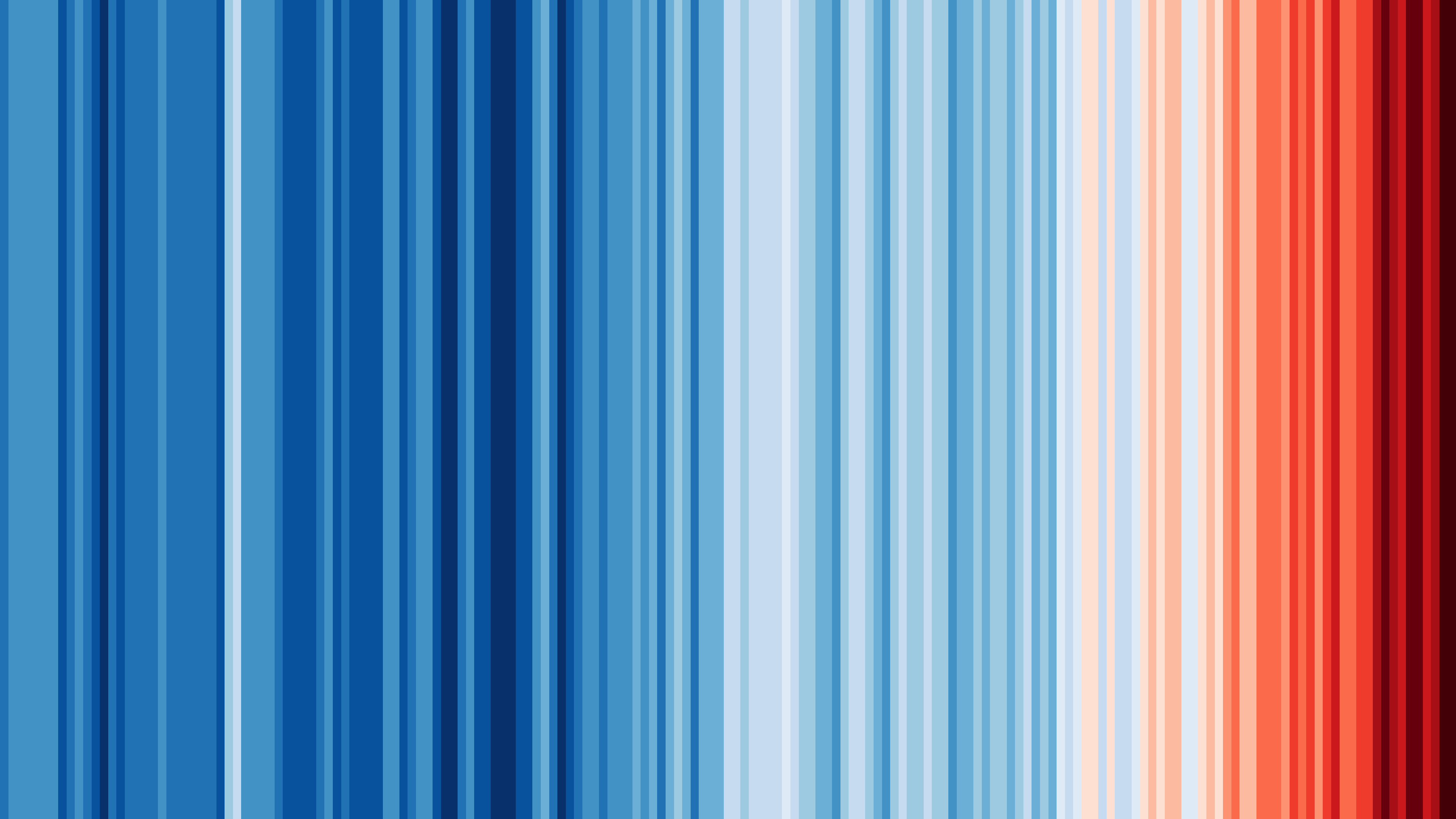
The world is – on average – getting warmer. To help picture this visually, look at the climate stripes below. From 1850-2024, red is warmer than average over the period while blue is colder than average. (This can also be conveniently worn on your body as a conversation starter…) If you’re a Youtube kid, I also highly suggest the NASA climate spiral here, where you can watch each year in a vertical time lapse.
Talking about averages, however – a vital measurement in climate science – tends to make the problem difficult to digest. After all, average warming of 1.5o C of – our most recent milestone – doesn’t sound like that much. Even worse, in America, we don’t even know what those dang Celsius mean! (1.5o C is about 2.7o F)
Pulling an average of a number higher, meanwhile, hides the drama in the extremes of the distribution. A heat wave in the 100’s, for example, could be 10-20 degrees warmer than the historical average for a given day even if the global year-round average is only up a couple of degrees. You can even see this day-to-day on your phone by clicking on the long-term average screen. Groups like Climate Central also have helpful tools where you can see global charts on each day’s difference from history.


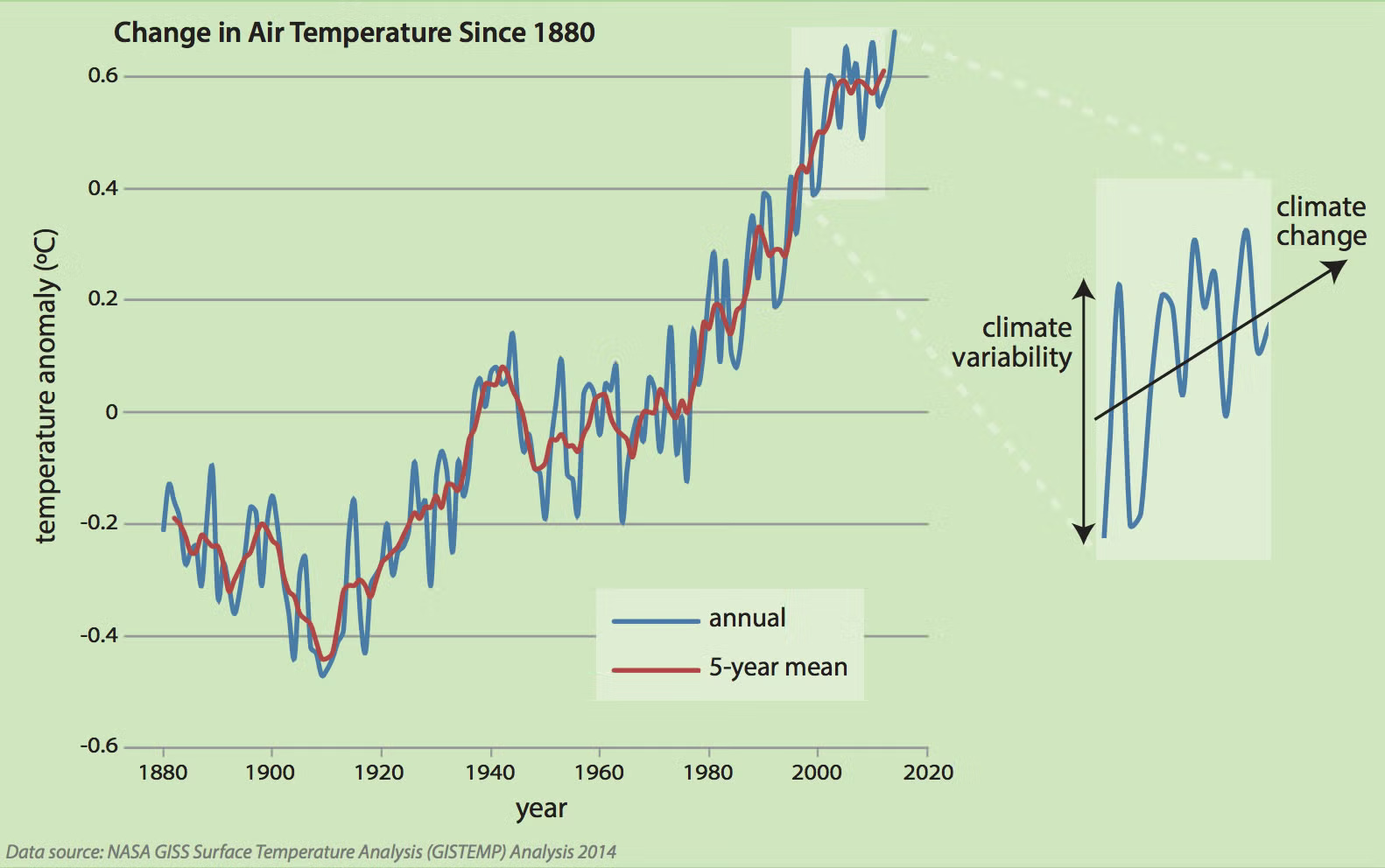
Even more confusing, climate is not weather. Take winter. Even as average temperatures warm up, we still have cold days. Climate change can also make extreme cold more likely by weakening of the Gulf Stream and allowing more polar vortices. (And, of course, the mere existence of winter means that using the term “global warming” has become a breeding ground for disinformation…) This helpful chart from the National Science Foundation’s UCAR program shows how yearly swings can change quite dramatically even as the average temperature heads higher.
怎么回事(The Why)
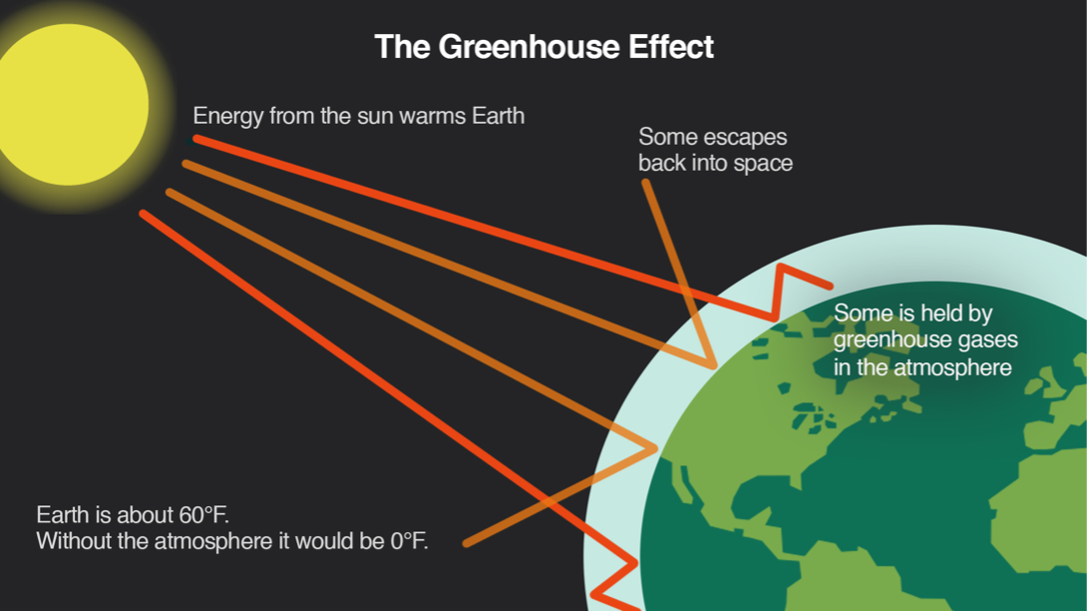
So, why is this happening? Or better yet, why does the Earth have heat at all? As you likely remember from Earth Science – my high school class was taught by our school’s terrifying wrestling coach – it’s because of the greenhouse effect. Because of our luscious atmosphere, which also allows us to breathe, certain classes of gas trap infrared heat from the sun. In fact, as the chart below shows, if we didn’t have an atmosphere, the average temperature of the planet would be 0o F – boof.
While the atmosphere is primarily nitrogen and oxygen (approx. 78% and 21%, respectively), small amounts of greenhouse gases – CO2, methane, water vapor, nitrous oxide, sulfur dioxide, and others – drive most of the heating effect. This is because: a) they tend to endure in the atmosphere for long periods and b) their chemical composition – and covalent bond structure – can absorb more energy. The chart below is a bit complicated to look at, but moving from left to right, you can see that greenhouse gases absorb different wavelengths of the sun’s radiation.
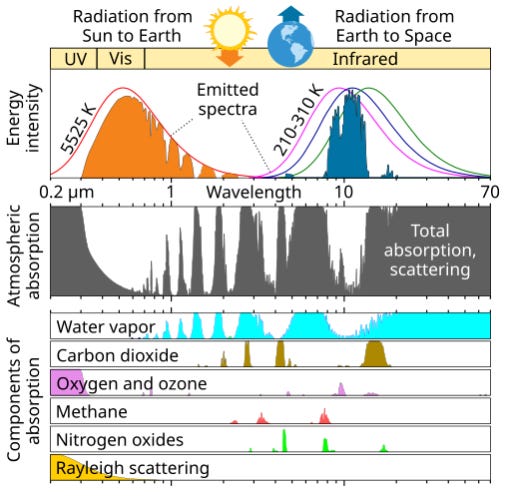
Carbon dioxide (CO2) and methane are likely the ones you hear the most about. CO2, meaningfully, “fills in the gaps” in water vapor’s absorption – and lasts a long time in the atmosphere.
(**Sorry, brief aside**: This is probably worthy of a full post someday, but I’m seeing a growing misconception even in some environmental circles that water vapor causes global warming. While water vapor is 90% of greenhouse gas volume, it’s actually a “feedback” of warming and not a “forcing.” Essentially, heat puts more water in the atmosphere, which then warms the atmosphere more. However, water only lasts about ten days in the atmosphere – it turns back into rain – while CO2 lasts about 100 years. That means the other greenhouse gases are driving the net warming. Check out this article from Yale Climate for more.)
Enough toots to fill the sky
Okay, I blacked out for a second there. Where was I? Oh, yeah, gas! While the big baddies of climate-forcing gases actually don’t make up that much of the atmosphere, they pack a punch. CO2, for example, is only around 0.04% of the atmosphere (which is why you’ll often hear it quoted in “parts per million.”) However, even those small concentrations have an incredible heating effect.
Other baddies, like methane, can have an even more extreme impact. To compare, you’ll often see emissions quoted for their “GWP” or 100-year Global Warming Potential. Methane, for example, has 127x the warming potential of CO2 despite lasting only about 12 years in the atmosphere. Sulfur hexafluoride (SF6) is even wilder at 22,800x. These ratios, however, allow us to translate different gases into their CO2 equivalent or CO2e.
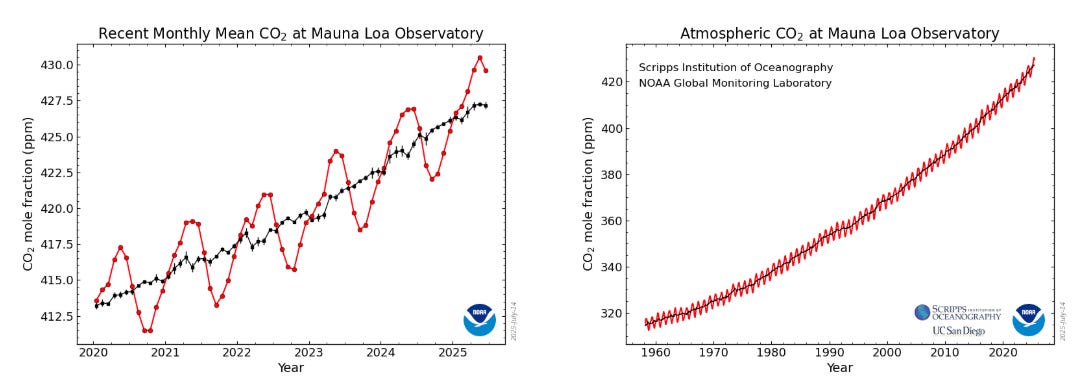
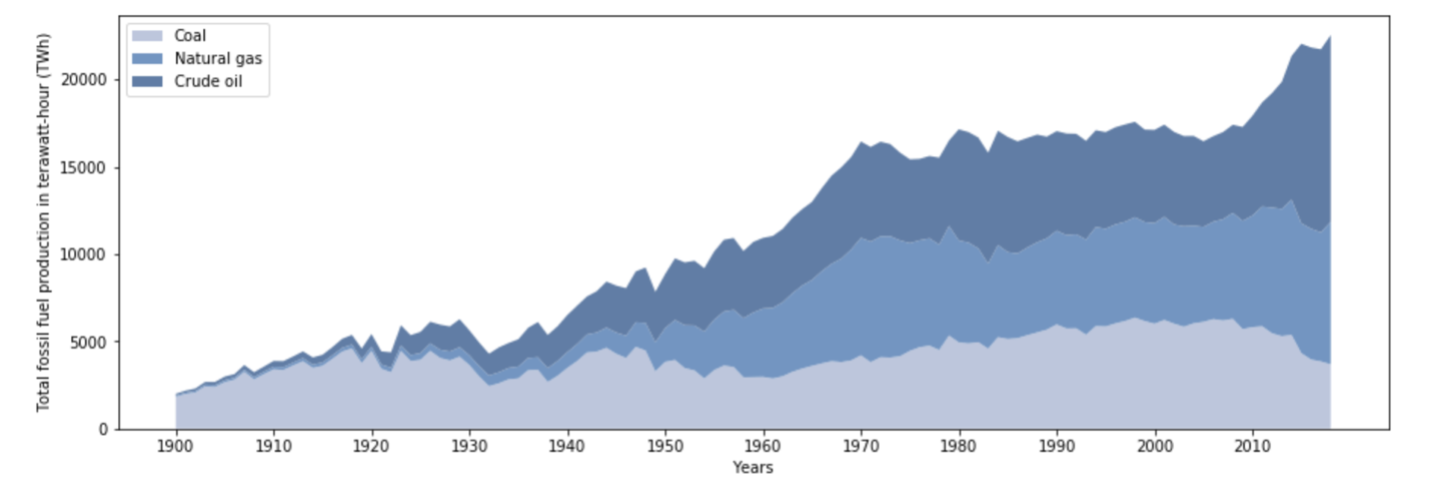
NOAA tracks this, tracing the fluctuations in atmospheric concentrations of CO2 (and others) in what’s often called a “Keeling Curve” (at least while NOAA exists as an agency…) Recently, we breached 430 parts per million (or 0.043% of the atmosphere), a level never seen in human history. And what, pray-tell could cause that? In short, the burning of fossil fuels (aka the mass concentration of toots).
What doom looks like
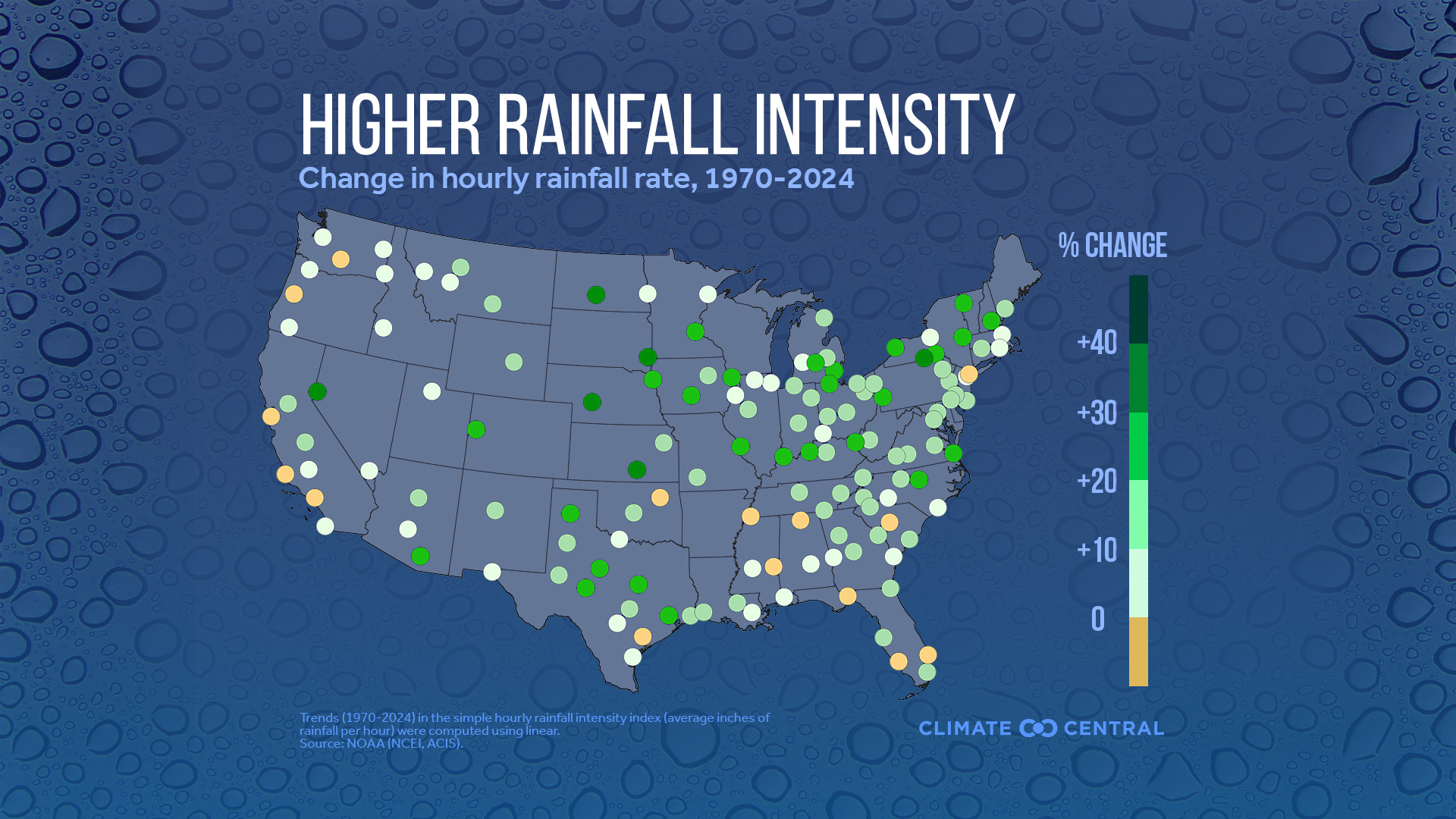
With all that science out of the way, why should we care? I mean, selfishly, as I’ve said before, a Big-Man-Blastoise like myself simply does not thrive in the heat. There’s also disruptive – and dangerous – changes in precipitation, storms, and crop loss that mean a warming planet will be harder for us to live on.
These small changes in average temperature and seasonal extremes are also really bad for the planet. NASA has some great examples at how subtle shifts can wreak havoc. For example, when sand is at 88 degrees instead of below 82 degrees, only female sea turtles can hatch. All of life on Earth has evolved assuming a set of parameters that remained relatively stable for thousands of years. From bugs that have to get moisture through their skin to an array of weather-sensitive eggs, organisms need stability.
How, though, would we get from the growing list of extinctions to apocalyptic doom? As we saw with those average temperatures, it’s a matter of degree. In his 2007 book, Six Degrees, scientist Mark Lynas laid out what progressive warming could do to the planet. And the prognosis is, frankly, terrifying.
At 2o C of (sustained) warming, coral reefs will be wiped out. At 3o C food scarcity becomes a massive threat (one recent study likened 3o C to “skipping breakfast forever.”) At 4o C, large swaths of the globe are uninhabitable – which would cause mass-migration and displacement. At 5o C, we’re past temperatures not seen in 55 million years, and at 6o C life (as we know it) is essentially wiped out. Certainly a doom-worthy scenario if I’ve ever seen one!
Progress – and the fight for every tenth of a degree
Thankfully, Mark Lynas didn’t stop writing books. In 2020, he wrote an update to Six Degrees called Our Final Warning. In it, he updated the science to see where we were compared to 2007. And thankfully, there was some great news: 5o C and 6o C no longer seemed realistic due to the progress we’ve already made in tackling climate change. While 2o C 3o C were more likely – and, remember, those warming levels come with very serious consequences – total annihilation is truly not the base case.
The antidote to those still-grim scenarios, however, will be how much action we take now. To limit human and animal suffering as much as possible, we have to fight for every tenth of a degree. 1.7o C, for example, is experientially very different from 2o C. Just look at how many storms, fires, and floods we have now as we approach (or pass) 1.5o C. This stuff really matters on the margins.
Where, then, have we made progress and where can we make more? First, as we often cover in the Carbon Fables, we have the technology we need already – and it’s cheaper than fossil fuels. Solar costs have dropped 90% since 2010 for utility-scale projects, and solar capacity increased 688% over the last ten years. And even as the US takes a giant step back on climate policy, the rest of the world is plowing ahead. In the first quarter of 2025, China installed a record 45.7GW of solar power – an entire POLAND of electrical capacity. The EU has also successfully decreased their emissions by 37% since 1990. The world is on the move.
Meanwhile, public opinion is moving in the right direction. Even in the US, 72% of US adults think global warming is real now (that’s actually high for us) and 59% acknowledge it’s caused by human activity. Even better? 66% of US adults support a rapid transition to clean energy (which is, as you can see, higher even than the percentage of adults who agree with the established science that human activity is causing climate change). Even people who doubt climate science would stand to save a lot on their utility bills through renewables.
What you can do
Here’s the best news of all: Even as US policy takes a sharp turn, YOU can keep fighting the fight – as I endlessly bore you with in this particular newsletter. You can electrify your life: EVs, heat pumps, and stoves. You can eat less beef, compost, and sign up for community solar. You can lobby your leaders to bring back the clean energy investments that just got wiped out by the Big (not-so) Beautiful Bill. I’m even heading to Washington DC this week to do so (and will report back post-haste!). And, more than anything, you can talk about climate. As these maps below from Yale Climate Opinions show, while most people believe in climate change now (orange map), almost no one talks about it regularly (blue map).
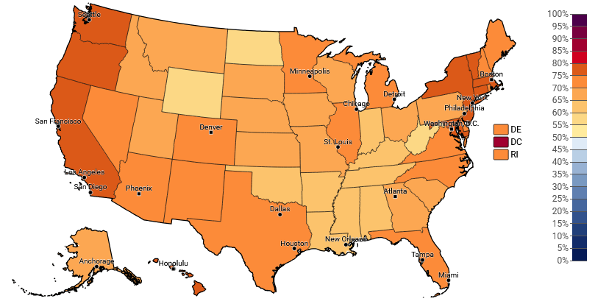
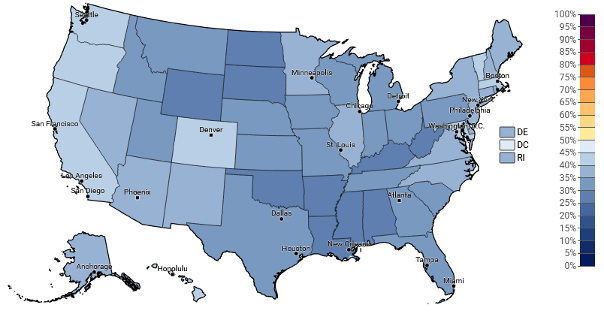
When you talk about climate change, however, do so with positivity. While many of us think we have to focus on the doom to wake people up (I too can be guilty of this), the science shows again and again that doom only shuts people down.
It may run counter to our interests, but humans are basically just apes with speech that respond viscerally to cognitive dissonance. More importantly, as Katherine Hayhoe recently outlined in her Substack, focusing on doom is not only untrue scientifically, it supports the oil & gas lobby that wants you to do nothing. As Mark Lynas showed us, while we are unlikely to be obliterated at 3o C, giving up on every tenth of a degree we can still win means inviting unnecessary suffering into the world.
Are we doomed? No. Am I hopeful? You bet I am. I have you on my side. Even if we’re a bunch of library nerds, we’re going to take back those degrees.
*Art by Philips Wouwerman, Battle Scene, c. 1645/1646, courtesy National Gallery of Art
**Email header art by Karl Nilsson (sigvardnilsson on instagram), includes portions of Beck's Castle Ruins by László Mednyánszky Denbigh Castle, W he ales by Edward Dayes & Paysage de la Grand Chartreuse attributed to Jean Lubin Vauzelle
I'm so glad these presentations are being so well received, as I haven't been able to attend one yet! Looking forward to lobbying with you this week, my friend!
Dear nerdy guy. I hate to be the one to tell you this,...but it is all over for the earth and the climate. You, actually all of us, have lost this final battle. The forces of darkness have won. All the facts and graphs and cheering is to no avail. The Earth's temperature will rise and rise. People are too selfish to care about the blue marble. They want their gas guzzling trucks and think recycling is a commie plot. The present American administration has nailed shut any hope of reversing the damage fo fossil fuel burning. We are doomed and you know it. Resistance is futile. The Paris Accords are useless. Really, it is OVER. Sorry for the doom and gloom, but apparently I am the only one not wearing rosy colored glasses. Mother Nature calls the balls and strikes and just yelled, STRIKE THREE!!! Really, it's over.